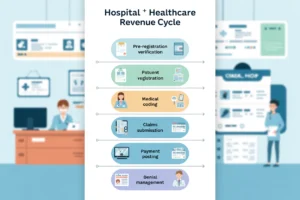

For many practices and hospital revenue cycle teams, prior authorization is no longer a simple utilization control. It has become one of the most disruptive forces in the front end of the revenue cycle. The impact is felt everywhere: delayed scheduling, angry patients, rising write offs, and an A/R profile that looks worse every quarter.
This is not just an administrative nuisance. Prior authorization issues drive avoidable denials, extend cash conversion cycles, and push staff burnout to dangerous levels. At the same time, payers continue to expand the list of services and drugs that require authorization, and they change rules frequently.
This article breaks down how prior authorization really affects your revenue cycle, why traditional fixes are not working, and what a modern, scalable operating model looks like. It is written for practice owners, group administrators, hospital RCM leaders, and billing company executives who need a practical blueprint, not generic advice.
How Prior Authorization Really Damages Cash Flow and Key RCM Metrics
Most organizations feel the pain of prior authorization in anecdotes. A cancelled surgery the day before. An MRI pushed out two weeks. A patient who never returns after a delay. To fix the problem, you need to translate these stories into specific financial and operational metrics.
Some of the most important revenue cycle KPIs affected by prior authorization include:
- Authorization related denial rate (claims denied for missing, invalid, or expired PA)
- First pass resolution rate for services that require authorization
- Average days from order to scheduling for high cost imaging, procedures, or specialty drugs
- Net collection rate for service lines with heavy PA requirements (oncology, cardiology, orthopedics, behavioral health, specialty pharmacy)
- Cost to collect per claim that involves prior authorization
In many organizations, these indicators quietly deteriorate over time. For example, a cardiology group may see authorization related denials climb from 5 percent to 10 percent of all denials within two years. Each denied claim can generate between 20 and 60 minutes of additional staff work when you factor in research, resubmissions, and appeals. That labor cost is rarely tracked directly, yet it is material to your cost to collect.
Another hidden effect is on the timing of cash. If the practice will not schedule until authorization is approved, the lag between order and service increases. That stretches your revenue cycle before the claim is even created. If you do schedule and treat without confirmation, you may bring in gross revenue faster, but your denial exposure skyrockets later. Either way, prior authorization distorts cash flow.
As a leader, you should ask your team for a simple report that segments claims into two groups: those with prior authorization and those without. Compare denial rates, average reimbursement, and days in A/R. In most environments, you will see that prior authorization is not a side issue. It is a central driver of working capital performance.
Where Prior Authorization Breaks in the Workflow
There is a strong temptation to treat prior authorization as a single step. In reality, it is a sequence of tightly coupled tasks spread across providers, schedulers, clinical staff, and billing teams. Failures at any point echo into denials and write offs weeks later.
A typical workflow for a service that requires prior authorization includes:
- Order entry in the EHR or practice management system
- Eligibility and benefit verification
- Determination of PA requirement based on payer, plan, and service
- Gathering clinical documentation and codes
- Submission through a portal, fax, or integrated API
- Ongoing status tracking, follow up, and response to payer questions
- Recording authorization details and dates in the scheduling and billing systems
Common breakpoints include:
- Order entry: The provider selects a generic diagnosis or omits key clinical details that payers consider “medical necessity” triggers. The PA specialist then spends time chasing documentation, or the request is denied outright.
- Requirement determination: Rules change constantly. Staff may use outdated cheat sheets, or they assume “this payer never needs PA for that service” based on old experience. As a result, services are scheduled without required approval.
- Submission mechanics: Different payers want different channels. One demands portal uploads with structured fields, another will only take faxed forms. Staff waste time navigating portals, saving screenshots, and rekeying data. Errors turn into delays and rejections.
- Status tracking: Without a central tracking tool, follow up is manual and reactive. Staff discover denials days later when a claim rejects. The team then scrambles to retro-authorize or appeal, often outside payer time windows.
To fix prior authorization sustainably, leaders must map this end to end journey for their top 10 to 20 high value services and payers. Every handoff and every decision should be explicit. Once you see the full picture, it becomes clear that “doing prior auth better” is not one project. It is a combination of better data capture at the point of order, rule intelligence, workflow tools, and accountability across departments.
A simple diagnostic framework
When you review your process, use a structured set of questions:
- What percentage of prior authorization requests are submitted within 24 hours of order entry?
- How many payer rules are stored in a searchable, maintained library instead of in staff heads?
- What share of authorizations are obtained electronically, versus phone or fax?
- How and where are authorization numbers, effective dates, and limits stored so that billing can reference them without hunting?
The answers often reveal why even hardworking teams cannot keep up with growing authorization volume.
Payer Behavior and Policy Volatility as a Strategic Risk
Most practices view prior authorization as a transactional problem. Payer behavior makes it a strategic risk. Health plans regularly expand PA lists, narrow medical necessity criteria, and alter frequency limits. Managed Medicaid and Medicare Advantage plans may follow different rules from their commercial parents. That policy churn quietly increases the cognitive load on your staff.
From a revenue cycle standpoint, this has several implications:
- Denial patterns change faster than many analytics tools update. By the time your denial management team identifies a spike in PA related denials, the underlying policy may have already shifted again.
- Local habits do not generalize. A rule that “worked” for one payer in one region cannot be assumed for others. Staff who rely on memory rather than a centralized rule base introduce inconsistency and risk.
- Back end teams are forced to operate like detectives. When a claim denies as “authorization required”, billers must reconstruct what the requirement was at the time of service. This rework disrupts normal A/R workflows and saturates limited denial management resources.
You should treat payer prior authorization policies the way a risk manager treats regulations. That means:
- Maintaining a curated, versioned library of payer PA requirements for your top services
- Using change logs so you know when a new rule went live, and which dates of service are impacted
- Aligning your coding and documentation templates with the clinical criteria that payers actually inspect in their PA reviews
Without this, your organization is perpetually surprised by denials that were predictable at the time the order was placed.
Staffing, Role Design, and Burnout in Prior Authorization Operations
Many organizations handle prior authorization “where it lands”. A scheduler calls the payer between other tasks. A nurse submits imaging requests between patient visits. A biller chases retro authorizations when claims deny. This diffusion of responsibility may feel flexible, but it is one of the fastest ways to burn out staff and lose control of financial outcomes.
RCM leaders should think of prior authorization as a specialty function that requires:
- Dedicated time and focus, not fragments of leftover minutes
- Deep payer specific knowledge that is maintained, not ad hoc
- Clear productivity and quality metrics
- Close coordination with clinical and scheduling teams
An effective staffing model typically includes some version of the following roles:
- Prior authorization specialists who own intake, requirement checks, submissions, and status tracking for defined service lines or payer portfolios
- Clinical reviewers (often nurses or highly trained medical assistants) who ensure that documentation and diagnosis mapping meet medical necessity standards
- PA team lead or supervisor who monitors queues, balances workloads, and reports on KPIs such as turnaround time and approval rates
From a metrics perspective, you should track at least:
- Number of authorization requests completed per FTE per day, segmented by payer and service type
- Average time from request creation to approval or denial
- Percentage of requests that require additional information, by payer
- Approval rate on first submission
Burnout often shows up as longer cycle times, growing backlogs, and rising error rates. If your team is handling a rising volume of PA with static staffing, you are likely living off “heroics” rather than a sustainable process. At that point, you should decide whether to add internal FTE capacity, increase automation, or selectively outsource portions of the workload.
Technology That Actually Moves the Needle on Prior Authorization
Technology alone will not fix a broken workflow, but without the right tools you will never scale. The key is to distinguish between cosmetic features and capabilities that truly change performance.
When evaluating or optimizing technology for prior authorization, focus on these functional areas:
1. Rules intelligence and requirement determination
Your system should help answer one question quickly and reliably: “Does this service, for this patient, with this payer and plan, require authorization, and if so, what type?” That requires:
- A maintained rules engine that can be updated centrally when payer policies change
- Integration with eligibility and benefits data, so that group, plan, and product type are considered
- Service line logic that differentiates between CPT or HCPCS codes, modifiers, and place of service
Without this, staff rely on spreadsheets, tribal knowledge, or payer websites, all of which invite error.
2. Submission and tracking workflows
Ideal capabilities include:
- Structured PA request templates that pull data from the EHR, including demographics, diagnoses, problem lists, and medication history
- Integration with payer portals or clearinghouse APIs, where available, to avoid duplicate data entry
- A centralized work queue that shows all open requests by status, payer, and priority
- Automated alerts when a payer asks for additional information or issues a decision
These features change the work pattern from reactive phone calls to proactive queue management. That directly improves staff productivity and reduces lost or forgotten authorizations.
3. Data capture for billing and analytics
Technology should not just submit and track. It must also capture the outputs in a way that billing and analytics teams can use. At a minimum, you should store, in structured fields:
- Authorization number or reference ID
- Service dates and any frequency or quantity limits
- Associated payer and plan
- Linked claim identifier or encounter number once billed
When these data are consistently available, denial management teams can quickly distinguish between true PA failures and payer misprocessing, and revenue integrity teams can correlate denial trends back to specific order sources, locations, or providers.
For many organizations, an incremental approach works best. Start by using technology for a handful of high volume, high dollar scenarios (for example, advanced imaging for top three commercial payers), then expand once workflows stabilize.
Designing a Prior Authorization Operating Model That Reduces Denials
Solving prior authorization sustainably requires more than tools or more staff. It requires an operating model that treats PA as an integrated component of your revenue cycle and clinical operations, not an afterthought.
A practical operating model includes five pillars:
1. Governance and ownership
Someone at the director or VP level should be explicitly accountable for prior authorization performance. Their mandate should cover:
- Policy management and payer rule changes
- Process design and standard work
- Technology enablement
- Staffing plans and training
- Reporting to clinical and financial leadership
Without this, PA remains “everyone’s problem and no one’s job”.
2. Standardized workflows by service line
Different specialties and services have very different PA dynamics. Your workflows for oncology infusion should not be identical to those for outpatient imaging. Develop service line specific playbooks that define:
- Which orders always trigger a PA review
- Expected documentation from the provider at the time of order
- Preferred timing and sequencing of scheduling relative to PA submission
- Escalation paths when payers delay or deny
Use these playbooks to train new staff and to align expectations with providers.
3. Provider engagement and documentation alignment
Many authorization denials are rooted in documentation gaps. RCM teams can influence this by working with clinical leadership to:
- Embed required clinical elements for common PA scenarios into EHR order sets or templates
- Educate providers on which details matter most to payers for their specialty
- Share simple denial dashboards at the provider or department level, highlighting avoidable PA breakdowns
When providers see that a few extra seconds at order entry can prevent weeks of delay and patient complaints, compliance improves.
4. Feedback loops from denials back to prior authorization
The connection between denial management and prior authorization should be formal, not incidental. Establish routines where denial analysts regularly feed patterns back to the PA team. For example:
- Monthly or quarterly reviews of top PA related denial codes by payer and service line
- Case reviews of complex denials to see whether earlier documentation or different codes could have avoided the issue
- Rapid rule updates in your PA requirement library based on new denial behavior
This closes the loop so that mistakes become learning opportunities rather than recurring revenue leaks.
5. Measurable targets and transparent reporting
Finally, define what “good” looks like. Set concrete targets such as:
- Reduce PA related denials by 25 percent within twelve months
- Reach a 90 percent first submission approval rate for selected services
- Cut average order to authorization turnaround time from five days to three days
Report these metrics at the same frequency and visibility as core revenue cycle KPIs like days in A/R and net collection rate. When prior authorization appears on executive dashboards, it receives the sustained attention it deserves.
When to Use Outsourcing or Hybrid Models for Prior Authorization
Even with strong internal processes, some organizations find that they cannot economically staff or scale prior authorization functions, especially across multiple locations or service lines. In these cases, outsourcing or hybrid models can make sense.
Outsourcing can help when:
- Authorization volume fluctuates significantly by season or campaign
- You are expanding into new specialties or payers where you lack experience
- Local labor markets make it difficult to recruit and retain specialized PA staff
- Your cost to collect has risen despite internal efficiency efforts
When evaluating a partner or designing a hybrid model, consider:
- How will work be divided between your staff and the external team (for example, vendor handles intake and submissions, internal staff handle escalated medical necessity disputes)?
- What service level agreements will govern turnaround times, accuracy rates, and response to payer requests?
- How will the partner integrate with your EHR, practice management system, and communication channels, to avoid duplicate work?
- What reporting will you receive, and how will it align with your internal KPIs?
In many successful models, organizations keep clinical decision making and complex appeals in house, while leveraging partners for high volume, rules driven components of the process. This lets you convert fixed labor costs into variable costs and scale more flexibly while maintaining control over clinical and financial risk.
Turning Prior Authorization from a Liability into a Managed Process
Prior authorization is not going away. Regulatory efforts may improve transparency or timelines in some programs, but payers will continue to use PA aggressively to manage utilization and cost. For independent practices, group practices, hospitals, and billing companies, the choice is simple: either treat prior authorization as a strategic, engineered process or allow it to quietly erode cash flow, staff satisfaction, and patient trust.
By quantifying the financial impact, mapping the true workflow, assigning clear ownership, aligning technology with real needs, and, where appropriate, using specialized partners, you can regain control. The payoff shows up in fewer avoidable denials, shorter A/R cycles, and more predictable revenue, but also in smoother scheduling and better patient experience.
If your organization is struggling with growing authorization volume, rising denials, or overwhelmed staff, this is the time to rethink your model, not just patch it. A structured redesign of prior authorization operations is often one of the highest ROI initiatives a revenue cycle leader can undertake.
Next step: If you want to explore how a reengineered prior authorization model could improve your cash flow and reduce denials, contact our team for a deeper discussion of workflow and operating model options. Reach out here to start the conversation.